Candace and I recently presented at the 2021 Research Impact Canada (RIC) annual conference (http://researchimpact.ca), discussing our collaborative explorations between the Regina Fire and Protective Services and undergraduate students in one of my Software Systems Engineering classes (People-Centred Design) at the University of Regina to engineer modern software applications for fire safety education. Enjoy!
Abstract: Over the past years, Regina Fire & Protective Services has provided an interactive activity, delivered by firefighters, designed to lead kindergarten to grade three students through the components of a family fire escape plan. While the original intent of this fire education program is still valid and necessary, the original design has become obsolete and lacks relevance with current technology and communication tools. In collaborating with the University of Regina Software Systems Engineering program, a modern technology was designed and developed by post-secondary students to evolve the teaching tool, saving lives by partnering education and the latest technology and engineering possibilities.
As with last year, my favourite conference event of the year is happening online and for free registration. Fellow creatives, register and set up your schedule now!
Although work is still ongoing, students in my Spring 2020 graduate class on “People-Centred Design” and I received an award for initial work in exploring new website (digital habitat) experiences for the RCE Saskatchewan Community. Exciting and great work students!
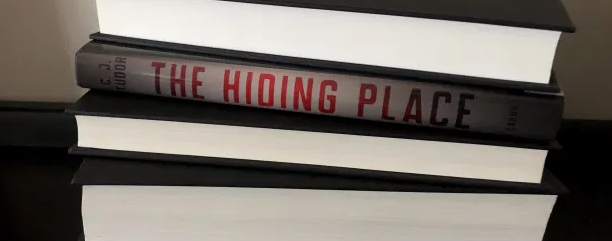
Quick update here, re: my plan for reading 12 (fiction) books in 12 months. March ended early with C.J. Tudor’s book, “The Hiding Place” which was a very decent read indeed! Tudor really is a fantastic author in my opinion. April, with typical end-of-semester shenanigans, saw me hit a hard pause on my reading adventures as my day-by-day work adventures were crazy long and by the end of each day, the second my head hit pillow, with heavy eyelids I quickly was swept off into a spacey dreamscape.
Well, long story short, here I am back at it trying to get back on track with “A Pho Love Story” by Loan Le.
With that, off I go to flip the first few pages/chapters! Not to start off making excuses but in full transparency, I’m teaching two compressed software engineering courses this Spring term (May-June) so things continue to be on the edge of crazy for me but I am really going to try my level-headed best to get back to reading. Getting back into reading (fiction) has been really great for my soul and general well-being!
Students in my Winter 2021 ENSE 405 class Designing Apps for Collaboration & Learning explored building community software tools in support of the United Nation’s (UNs) 17 Sustainable Development Goals (SDGs). In educating software engineers about the UN’s SDGs it is my hope that they take the idea out in industry – that the software they produce out in the world should at a minimum attempt to positively move us forward as a society. Understanding the UN’s SDGs can go a long way to help in my opinion. As part of student project work, I asked students to produce a brief commercial of their innovative solutions. Check them out below! (alphabetical by project name). Enjoy!
“Climate Awareness” by Mohamed Bashir addressing UN SDG #13 Climate Change
“Community of Meal Planners Forum” by Kelly Holtzman addressing UN SDG #12 Sustainable Production & Consumption
“Let’s Get Physical” by Clark Inocalla addressing UN SDG #3 Good Health & Wellbeing
“Project Vitality” by Jaskirat Josan & Oni Ayonoadu addressing UN SDG #2 Zero Hunger
“Recycle Smart” by Tim Pasion addressing UN SDG #12 Responsible Production & Consumption
“Sustainable Product Guide” by Sana Khan addressing UN SDGs #11 Sustainable Cities & Communities as well as #12 Responsible Production & Consumption
“Tailored Diet” by Sam Iregbu addressing UN SDG #3 Good Health & Wellbeing
“Youniversity” by Brandon Clark & Ji Woun (Brian) Kim addressing UN SDG #4 Quality Education
Software Systems Engineering student Jack Zhao was the lead designer and developer of the app. The app is going live soon! I couldn’t be more proud of Jack’s efforts on this project!
Our research team presented at EngAGE’21. Our work, which extends the excellent work from our Software Systems Engineering capstone students (Nicolas Achter, Nickolas Schmidt, Nikolas Lendvoy, and Shayan Khan) seeks to explore how technology can support ageing at home. Please watch our presentation and comment away!
Exciting news! Ramona, Cheryl, Bill, and I (researchers and innovators from the Johnson Shoyama Grad School of Public Policy, Eden Care Communities, & the Faculty of Engineering) were successful in acquiring funding from SHRF to build on the excellent work by 2019-2020 Software Systems Engineering capstone students Nicolas Achter, Nickolas Schmidt, Nikolas Lendvoy, & Shayan Khan (i.e. The Ni(c)(k)S), exploring how technology can improve virtual home care experiences in Saskatchewan
I recently read an article by Dave Cormier titled, After Cheggification – A way forward (Part 1) that I thought quite interesting (I’m also looking forward to Part 2+). I echo much of what Cormier discusses as you will read below. Brief summary: there are sites like Chegg (and others) that are advertised as student learning/study sites. However, what students typically use these sites for is to upload structured questions to the site(s), questions that typically only have one right answer, and the “site community” spits out answers back to them (not always correct, but more often than not) for students to use on assignments and exams.
Now, the web has been a portal for “learning and the like” such as this for as long as I remember, dating back, for me, to the early days of the mid-to-late 1990s when I started getting into computer science and, soon after, software design and development. Even myself, back in my undergrad, I often would search the web looking for additional learning material to supplement my understanding of lecture and lab material. Although I did try my best to adhere to Uncle bob’s programmer’s oath (#2, #5, #9) – there were times WAY back in the day where I came close to touching the sun so to speak with some of my learning findings not fully, completely (#thehip) understood #notverypragmatic. It was another Bob – Bob Hilderman (a since retired computer science teacher) – that brought me back into the fold and for that, I am forever grateful to him. As an aside: the idea here is that we can all reflect and learn from our mishaps, missteps, and mistakes. I did – and through hard work and through many a failure and the odd success, came out the other side with a Ph.D. As well, another idea here is that we should never put getting the grade over real learning, a philosophy I often find missing in students and teachers (we really need to do our part too!). For me, I do my level-headed best to try to highlight this to my students in all my classes #thepragmaticprogrammer #ense374 #notjust374. Show me your progress! I proclaim “Give me your tired, your poor, your huddled [explorations] yearning to breathe free.” “Show me what you got” #rickandmorty.
Some folks, such as myself (sort of), view the fact that – hey, the knowledge is out there – and hey, it’s OK. If not directly copying from sources, you are technically still learning (you’re searching, researching, condensing, conversing, you’re “knowledge managing”!). Cormier actually taught a MOOC on Rhizomatic Learning that had a topic along the lines of “cheating as a form of (collaborative) learning.” The fact of the matter is that the knowledge is out there – I’m not sure we can (or even would want to) go back. Sure sites like Chegg have amplified things but as educators, we’ve always had to deal with stuff like this, and it’s likely only going to continue to be/get amplified.
With the swift move to remote as a result of COVID, and the amplification of “learning” sites like Chegg popping up, faculty have responded, according to Cormier, by:
Making exams harder by asking more questions, making questions harder to understand/more difficult, challenging to complete within an allotted time frame, etc.
Entrapment by registering, lurking, and trolling students who use sites like Chegg to catch students in the “learning” act
Having longer open/take-home exams supplemented by larger assignments/projects
At the heart of the issue to this response by faculty according to Cormier is that bullet 1 and 3 increase the stress already experienced by students. With this, I’ve had many conversations lately with my students about these responses in particular, with what I would consider good students who are struggling in this new way of doing things. I indeed get it! And bullet 2, at least to me, seems to be a rather unethical approach towards our attempts at “solving” rather unethical behaviour. All-in-all, a no-win situation. Although bullet 3 speaks to me…if PDSA’d in proper fashion. More on this below.
For me – this discussion comes down to our role and responsibility as educators and the experiences we provide our students with respect to their “true”/real learning. In true “engineering” fashion – I use engineering but any designer/developer in any field knows what we have to do here – we analyze the data, information, and knowledge in front of us – we’re all knowledge managers here per see, and we adapt ourselves – we PDSA! In my opinion, we can’t simply teach online the same way we’ve done so in the classroom. Actually, I question the very idea that the traditional form of classroom teaching was ever the best environment for our learners anyway (I struggled with it too as my creative mind often wanders and I may miss things). I think a nice PDSA-style solution is the exploration of the constructivist approach, mixed with an apprenticeship (coop and beyond) model to help students get their creativity back. In Mandolarian terms – this is the way. Or at least this may be a better way.
When trying to gauge whether my students understand I’ve always been drawn to teaching through the ill-structured. This loosely may relate to what engineers call open-ended design, where, briefly stated, one true/real answer doesn’t exist. I like this idea of learning as it places the learner in a situation where curiosity is key, where learning by “cheating” becomes more difficult, leading to an environment more in tune with the real world. The balance here is to not overwhelm the already potentially overwhelmed. Myself, in my teaching, I try my best to do this by setting up a “safe-fail” (aka, Dave Snowden), albeit graded environment where, like John Dewey, Paulo Friere and the like have eluded, my students can use their curiosity to experientially and reflectively learn and grow their knowledge (individually and socially) through smaller, piecemeal explorations. Again, I like to think that this is the way and I don’t think I’m alone, as deGrasse Tyson describes in the video below.
Now, Cormier talks about the use of structured questions as a possibly preferred way for educators to gauge understanding. Recall from above, those questions that typically have one right answer. Those questions that might lead to the Cheggification of answers. With structured questions, however, rubrics can be created and followed by educators and learners alike to ensure fairness in understanding work deliverables and evaluation. This type of learning can work, maybe, if in the right context (I’ve never been a true believer in rigid rules and exams like multiple choice but maybe there is a place for these still). And for educators, things are easier to grade as there is a checklist of sorts. However, often is the case, in my opinion, that the curiosity of the learner takes a backseat to the learner simply, and numbly, striving to get the grade. When I think of Dave Snowden’s cynefin framework, I see this type of learning and educational facilitation as being in the simple/obvious domain. In my opinion, we need this – really we do – as it provides a foundation; a solid basis for learning – but also we need more. We actually need students and educators to facilitate and experience learning through all of the domains of cynefin – structured and the ill of it all.
So in my opinion we need to explore ways for our students to learn better – without the fear of failing – whilst also enabling us educators to be able to gauge and grade on understanding accordingly. Although I personally lean favourably towards the ill-structured, we should not just get rid of structured learning explorations due to the Cheggification of learning (or by the fact that I don’t like them). The web, and sites like Chegg, are not going away. Furthermore, there is and has been evidence to suggest that a structured approach is helpful to learners as well. See the 2006 article by Roediger and Karpickle titled, Test-enhanced learning: taking memory tests improves long-term retention, which explains essentially this (among other research works).
Typically, historically (?), however, at least what I have seen, heard, and experienced, educators have utilized structured questions on assignments and exams as the sole, or highly weighted indicator/gauge of student learning and understanding. However, perhaps exams and assignments are not the best places for these types of learning/knowledge explorations, but where then? Like comparing apples-to-oranges, students are a diverse group and their curious explorations take us educators down many pathways as the below image illustrates (I love this image).
What I’ve been doing, with the hopeful goal of positively evolving my teaching, is to set up and facilitate a learning environment that provides my students with ill-structured explorations in smaller-scale course projects and exams, like previously mentioned, supplemented by structured learning explorations in the form of graded interactive quizzes and discussions embedded into my lecture slides and presentations. All of this in support of my students’ curiosity while they are exploring in the ill, as well as in support of my students’ foundational upstanding and long-term (knowledge) retention of important course topics and ideas while they explore in the struct. I operationalize the latter through the use of cool software technologies such as TopHat and Adobe Captivate (I’ve also explored Mentimeter, Socrative, and H5P but TopHat and Adobe Captivate are the bees-knees!)
Concerning TopHat – I used TopHat primarily pre-COVID in my live lectures and found it worked very well for not only improving student understanding but also student engagement. Truth be told, I love TopHat. It’s awesome – highly usable and delightful software. That said, I also hate TopHat. This, really solely due to its pricing model as it charges students a fee for use (it doesn’t charge me). I mean, yuk! Students pay enough already!
Concerning Adobe Captivate – During (and most likely post) COVID, I am using it (and will likely continue to use it) to essentially do this as well. Truth be told, I also love Adobe Captivate (the interface is a little buggy but the pros outweigh the cons) as I can provide my students with asynchronous (pre-recorded) interactive (structured quiz-embedded) lectures that they can watch/interact with over and over again building their knowledge and long-term retention of it all. Adobe Captivate also has SCORM functionality that connects to my institution’s Learning Management System (Moodle) to give me real-time analytics regarding my students’ progress in my courses and real-time knowledge regarding my students’ understanding of lecture topics. It’s really an awesome thing!
So, long story short, or as the kids say TLDR (this disclaimer should really be at the top of this post…sorry…ha), both structured and ill-structured explorations, in my opinion, are important for our students’ curiosity and learning. As educators, again, in my opinion, I think we need to evolve our approaches accordingly to provide more real, or humane (a better word?), learning environments. We can’t simply mirror what we’ve been doing in the classroom (did it really ever work anyway) and we can’t simply dump the content online and run away. I’ve been exploring some ways mentioned above in my teaching and things have been going well, not perfect but definitely, things are going very well! I’ll continue my explorations with the overarching goal of positively evolving my teaching to see where I can go to make my students’ learning time a positive one. If you’re interested in finding out where I go, come back from time to time.
Having finished Helen Hoang’s book, “The Kiss Quotient” early I am able to continue my goal of 12 books in 12 months in 2021 early!
First, Hoang’s “The Kiss Quotient” was a great read. The characters were lovely and the story very heartwarming. This said, I do feel the need to mention that this book was also the “steamiest” rom-com-ish book I have ever read! Sweet sassy mollassy…whew! …and I mean whew!! I do highly recommend giving it a read if you like rom-com type books though. It had all of the things you look for in such a read. And again #juicy …hahaha
Next up is C.J. Tudor’s book, “The Hiding Place.” I’m looking forward to diving in here as I’ve read and loved Tudor’s other books, “The Chalk Man” and “The Other People.”