Something new I’m trying this year is documenting all of the books I’ve read, or listened to (I’m a huge Libby/Audible/audio book fan), through the year. Pre-2022 I didn’t really read much of anything, minus computer science and software engineering books for work (boring!). That all changed when I got into audio books around that time and have read/listened to more and more books each year!
All of the books I encountered in 2025 were very good, great even! If I were to pick a few standouts, they would be (in order of most favorite, #1. But really all books were good!):
Onyx Storm by Rebecca Yarros
Shield of Sparrows by Devney Perry
Legends and Lattes by Travis Baldree
The Wedding People by Alison Espach
The Guncle by Steven Rowley
Dial A for Aunties by Jesse Q. Sutanto
Christmas at the Ranch by Julia McKay
The AI Con by Emily M. Bender and Alex Hanna
The Smiling Land by (the) Alan Doyle
Any Troupe But You by Victoria Lavine
Overall, I read (or listened) to 29 books in 2025. Here they are (in the order I read them in, from January through December 2025)!
There really are some fantastic reads listed there! Here’s to good reads in 2026! -tMac
‘Tis that time of year again for my annual top 10 albums of the year. These are actually albums of last year/2025, since 2026 is well underway. 😉 As usual, there were a lot of great albums. I’ve slowly dwindled them down to a top 10, with a few honourable mentions. Let’s get at it!
Honourable mentions include (Alphabetical):
Alan Sparhawk & Trampled By Turtles, Self Titled
Big Thief, Double Infinity
David Byrne & Ghost Train Orchestra, Who Is The Sky?
Dream Theater, Parasomnia
The Lemonheads, Love Chant
Lowest of the Low, Over Years and Overnight
Matt Andersen, The Hammer & The Rose
Rise Against, Ricochet
Samia, Bloodless
Stephen Fearing, The Emapthist
Teenage Bottlerocket, Ready To Roll
10. Colter Wall, Memories and Empties. A good ‘ol boy from Saskatchewan. Colter’s voice sounds 40 years older than he himself. This is classic, old school country goodness. Favs include: The Longer You Hold On, Like the Hills, 4/4 time, Memories and Empties, and 1800 Miles. I love how he snickers at his great pup in this video! 🙂
09. Jason Isbell, Foxes in the Snow. I’ve been a super fan of Jason for quite some time. A highlight of one of the last Regina Folk Fests (RFFs, please come back!) was seeing him with my brother and sister. This is a great album. Favs include: Don’t Be Tough, Ride to Robert’s, Foxes in the Snow, Gravelweed, and Good While it Lasted.
08. Skydiggers, Dreams & Second Chances. One of my musical influences, the ‘Diggers came swinging with this beauty last year. Just a good toe tapping adventure. Favs include: Dreams and Second Chances, Snow Blind, Don’t Change a Good Mind, Mother’s Pocket, and Start Again.
07. Julian Baker & TORRES, Send A Prayer My Way. What a great album we have here. Baker and TORRES really shine through every song! Such harmonies. So good! Favs include: Sugar in the Tank, Dirt, Goodbye Baby…pfft…who am I kidding, from start to finish, great!
06. The Burning Hell, Ghost Palace. Mathias and Ariel come at us with this fine album. The poetry of lyrics and the vibes of the tunes just make me so very happy. “I’d rather be a duck than a decorated shed” each and every day! Favs include: What Does It Do and How Does It Work, Celebrities in Cemeteries, Duck vs. Decorated Shed, Summer Olympics, My Home Planet, Luna FM, Brazil Nuts and Blue Curacao…Oooooo 🙂 All of it is so very great!
05. Lucy Dacus, Forever Is A Feeling. Lucy is one of my favorite singer/songwriters. She can rock, she can mellow it up, she’s super talented on the guitar, and her voice!!! She’s just a wonderful human. This album came out WAY in January of 2025 and it stayed with me throughout the year! Favs include: Best Guess, Ankles, Big Deal, For Keeps, Come Out, Modigliani, Bullseye…what am I doing. It’s all great!
04. Yukon Blonde, Friendship & Rock ‘n’ Roll. What a great rock ‘n roll album we have here. Just toe tapping goodness from start to finish! Everytime I hear a song on this album, a grin from ear to ear and a booble head is all anyone sees. So damn good! Favs include: Colours of My Dreams, Waiting on a Call, I’ve Got Yours, This Night, One of These Days…again…all of it is great!
03. Sloan, Based On The Best Seller. One of my fav bands of all time! In 2025 I dragged Nova out to the Casino to see these folks and boy oh boy, they did not disappoint! The gang comes out swinging on this album. As with my #04, toe tapping goodness here! Favs include: Live Forever, Dream Destroyer, Congratulations, No Damn Fears, Baxter, Capitol Theatre…and again…all great!
02. Taylor Swift, The Life of a Showgirl. Another great album from this superstar talent and wonderful person. I can’t believe she co-wrote and recorded this between her epic Eras tour. Taylor has simply got it! Favs include: Eldest Daughter, Opalite, CANCELLED!, Wi$h Li$t, Honey, The Life of a Showgirl, Actually Romantic, Ruin the Friendship…and ya…do I have ’em all…haha…regardless, all songs, all toe tapping goodness here.
01. Dan Mangan, Natural Light. Dan is one of Canada’s precious gems. Such an amazing singer/songwriter/bandleader. This album is so very great. One of my most memorable musical memories is seeing him jump into the audience at Darke Hall with his band and without a mic, brought the house down! Every song is a treat, but to pick a few favs: Diminishing Returns, No Such Thing As Wasted Love, It Might Be Raining, Cut the Brakes, Hit the Wall, Sound the Alarm, and Soapbox, Proximity. All of it…so good! And so good I’m posting two tunes!
And there ya have it! As always, keep listening to the good tunes, and to all the people who make music, bring on more in 2026! -tMac
This is coming in WAY late. But better late than never!
Life-wise, 2024 was a very difficult year. Things were rolling along very well. The Winter teaching term went well. In summer I geared up to go on a 6-month sabbatical. I began my focus on research grant writing, and it was coming along nicely (I had to steer in another direction but I’m hopeful on the new direction I took. I’ll find out in June if I’m successful #fingerscrossed). And then BOOM, the Fall hit…
In late September, my mom suffered a severe stroke and my mom’s world, and all of my family’s world was turned upside down. Suffice it to say, this was a life changing event for my mom and family, something we are all still navigating today.
In January this year, normally when I do my yearly reflection, I had to go back to work, very ill-prepared to do so while also trying to navigate helping my mom and family to the best of my ability. As I (finally) start to write this review and reflection here at the end of April, taking advantage of an LMS/URCourses end-of-term maintenance update that has gone astray and is preventing me from finalizing student grades, I take a moment to pause, breathe, reflect. My family and I – We are doing as well as can be. My mom, the “rock” of our family that she is, is settling into her new normal and taking things day by day. She is now living at Harbour Landing Village where she is settling in, getting the best possible care, and the rest of us our doing our level-headed best to help as best we can. I’m not going to lie, it’s not been an easy time for my mom or for any of us. But, family! We do our best to support each other!! And this, we are doing! And my mom is still our “rock.” She truly is the best of the best (she’ll hate me for posting this pic, but I think her beautiful soul shines right through here).
OK. Back on track. As 2025 unfolded over the last few months, I took advantage of listening more to my top 40 or so album picks for my annual top 10 albums of the year. As with most years, it was hard to get things down to just 10. But as always, I get my list started with a few “notables” I squeeze in for good measure to help me out (ha). So, let’s get at ‘er.
Honourable mentions (no particular order)
Elliot Brood, Town and Country
Japandroids, Fate & Alcohol
The Black Keys, Ohio Players
Cuff the Duke, Breaking Dawn
Serj Tankian, Foundations
Ministry, HOPIUMFORTHEMASSES
The Black Crows, Happiness Bastards
Taylor Swift, The Tortured Poets Department
Pearl Jam, Dark Matter
The Strumbellas, Part Time Believer
The Mavericks, Moon & Stars
Iron & Wine, Light Verse
Luke Combs, Father & Sons
Nathaniel Rateliff & The Night Sweets, South of Here
The Smashing Pumpkins, Aghori Mhori Mei
Joel Plaskett, One Real Reveal
Brothers of Metal, Fimbulvinter
Pixies, The Night the Zombies Came
Soccer Mommy, Evergreen
Pfftt…OK…I told you it was hard. So many gooders!! But here we get to the top 10 of it all! These albums were solid from start to finish. All songs on all albums, solid!
10. Green Day, Saviors. What can I say? These fine lads have been a staple since my early high school days. This album does not disappoint. Just a good time! Favs include: Look Ma, No Brains!, Living in the ’20s, Goodnight Adeline, Father to a Son, and Strange Days Are Here To Stay.
09. Lost Dog Street Band, Survived. This was a band I was introduced to in 2024. Having formed in 2010, I was sort of surprised I had never come across them. A little more country-iswh, very bluegrassy, with some folk goodness sprinkled in there to boot. All super great! Favs include: Last Train, Son of Tennessee, Muhenberg County Line, Lifetime of Work, and Survived.
08. Unleash the Archers, Phantoma. Another album from these very fine British Columbia heavy metal queens and kings. I find that with each new album these folks put out into the world, they keep refining their talent. Such a great album! Favs include: Gods in Decay, Ghosts in the Mist, Ph4/NT0mA, Green and Glass, and Blood Empress. Damn…it’s all great!
07. Bleachers, Self Titled. Jack Antonoff is one super duper talented musician, producer, etc. And when he assembles his band of merry and talented cohorts, my goodness do they ever make beautiful music. Every album these fine folks put out into the world is a gem. Favs include: Tiny Moves, Modern Girl, Woke Up Today, Jesus is Dead, Hey Joe, and Self Respect.
06. Gillian Welch & David Rawlings, Woodland. Gillian is one of those singer/songwriters that gives me the goosebumps when listening to her voice. David too, mind you, is also great! This album is sooooo very good. All songs shine, but favs include: Turf the Gambler, The Bells and the Birds, North Country, the Day The Mississippi Died, and Empty Trainload of Sky.
05. Alan Doyle, Welcome Home. One of my favourite musicians and people. Alan (and Co.) never disappoint on any album he and his band release. He is one of Canada’s greats, from Great Big Sea to now, with his solo stuff. It’s all so very good! Favs on this album include: Hard Old Hands, Best I Never Had, Long Night, Welcome Home, Your and Mine, All for a Song, and How Did We Get From Saying I Love You.
04. Judas Priest, Invincible Shield. Well what can I say? The Metal Gods came back with this little ditty of an excellent album. I must say, my prolonging of doing my annual album top 10 benefited this album as I never really gave it its due last year as it got lost in the hundreds of albums I had in the queue in ’24. I have to give kudos to my brother Joey who was like, “you need to give that more of a listen.” And oh man, am I glad I did. This is Priest’s best album since Painkiller (1990), of course, in my opinion. Favs include: As God as my Witness, Giants in the Sky, Trial by Fire, The Serpent and the King, Vicious Circle, Invincible Shield, and The Lodger. Crank it to eleven folks!! It’s all great!
03. Hurray for the Riff Raff, The Past is Still Alive. Although coming on the music scene in 2007, I had only just found out about Alynda Segarra’s band in ’24. This album is a delight from start to finish, and having since gone back to listen to their previous albums, folks, they are all great! I simply love all songs on this album, but to pick a few super favs: Alibi, Hourglass, Hawkmoon, The World is Dangerous, Buffalo, and Snake Plant, and every other song…ha!
02. Waxahatchee, Tigers Blood. Another person (Katie Crutchfield)/band I had just encountered in ’24, but have been around since 2010 (I think I may have been living under a rock!). This is just a fantastic album. Every song shines. Like Alynda’s stuff (Hurray for the Riff Raff), I’ve since gone back to Katie’s back catalogue and ya, it’s all great! On this album, like the last one (my #3 pick), every song shines. But to pick of few favs: Lone Star Lake, Burns Out at Midnight, Crowbar, 3 Sisters, The Wolves, and Tigers Blood, and ya, it’s all great! Give it a spin ASAP!
01. John Moreland, Visitor. This man has such a soulful voice and beautiful spirit. I must say, it also has a couple of my favourite lyrical passages/song titles: “The More You Say, the Less it Means,” so very true (I try to practice this everyday but fail quite often), and “One Man Holds The World Hostage,” this one very reminiscent of the man down south holding its citizens and the world hostage (or maybe it’s more like two men doing it). This whole album is a gem, but to pick a few favs (minus the two I’ve already said): Will the Heavens Catch Us?, Gentle Violence, Ain’t Much I Can Do About It, Visitor, and….you know what, every song is great. Like with my 02, 03, and all thee rest, listen to them all ASAP!
In the video below, the first two songs are from John’s 2024 album and the latter two are from his 2013 (In the Throes) and 2015 (High on Tulsa Heat) albums respectively (his whole catalogue of albums are all great so why not check ’em all out!).
And there we **finally** have it. How I saw and heard music in 2024, with a little bit of life happenings sprinkled in. Life is still moving along for me and my fam, and the 2025 music scene is looking bright so far too. I imagine I’ll have a hard time with my top 10 this year too! -tMac
Another trip around the old star in the sky means it’s time for my reflections on my top (10+) album picks of the year. There were indeed some gooders out there but I’ve dwindled ‘er down as I could. Let’s start with some notables beyond my top 10ers. In no particular order, these are all deeecent!
Queens of the Stone Age, In Times New Roman…
Lowest of the Low, Welcome to the Plunderdome
Arkells, Laundry Pile
Rancid, Tomorrow Never Comes
Sincere Engineer, Cheap Grills
Greta Van Fleet, Starcatcher
Avatar, Dance Devil Dance
Odds, Crash the Time Machine
King Gizzard & The Lizard Wizard, PetroDragonic Apocalypse; or, Dawn of Eternal Night: An Annihilation of Planet Earth and the Beginning of Merciless Damnation
Elliot Brood, Town
And now for my top 10s. To be honest, it was super hard to pick the ordering here (but undeniable were my top 3 picks – YouTube music stats confirms them to be too 😉
10. Noah Kahan, Stick Season (We’ll All Be Here Forever). My sister Krista introduced me to this dude this year. Pretty darn great indeed. Favs include: Stick Season, Northern Attitude, Strawberry Wine, Dial Drunk, Everywhere, Everything, and All My Love.
09. Chris Stapleton, Higher. Such a solid album with excellent musicianship and songwriting. Plus, this man’s voice…sweet lawd it be darn great! Favs include: Trust, Higher, The Day I Die, It Takes a Woman, White Horse, and What Am I Gonna Do.
08. The Rural Alberta Advantage, The Rise & The Fall. One of the best out there! Like all of their other albums, this one does not disappoint. They have this rhythm and drone-like tone in many of their tunes that you can just feel in your bones. All toe-tapping goodness here. Favs include: Plague Dogs, Conductors, Candu, 10ft Tall, and Late September Snow.
07. The Beaches, Blame My Ex. What a fun album we have here. Although these folks have been around for 10ish years, I just came to them this past year. This album is a fun time indeed. Was a constant at the gym on the ol’ treadmill! Favs include: Shower Beer, Blame Brett, What Doesn’t Kill You Makes You Paranoid, Edge of the Earth, and If a Tree Falls.
06. The Gaslight Anthem, History Books. I’ve loved these dudes since the start. Coming back with this doozy of an album after being on a very long break. So happy! Favs include: Positive Charge, Little Fires, History Books (with the Boss baby!), Spider Bites, Autumn, and A Lifetime of Preludes.
05. Gregory Alan Isakov, Appaloosa Bones. Another one that has been around for some time that I just came into this past year. Like others on here, the voice is just sooooo good. When having a little bit of a stressful day, week, whatever, I put this album on and it calms the soul. It’s all great but picking a few favs: Appaloosa Bones, Before the Sun, Watchman, The Fall, …it really is all great from start to finish.
04. Jason Isbell and the 400 Unit, Weathervanes. Another fantastic album from one of the best singers, songwriters, and musicians around, not to mention he surrounds himself with the same. From start to finish, this is one great album! But as usual, a few favs include: Strawberry Woman, Death Wish, If You Insist, Cast Iron Skillet, White Beretta, Save The World, damn…it’s all great!
03. Samia, Honey. Randomly popping up in the YouTubes was Samia’s tune “Honey.” I was hooked immediately. Such great tunes and such a voice. This album was on a constant rotation since it came out WAY back in January. I love it all but some favs include: Honey, Amelia, Kill Her Freak Out, Charm You, Breathing Song, Nanana, …this is pointless. Every tune is great from start to end.
02. Boygenius, The Record. And here we are nearing my top pick with these fine folks. I truly think that these three on their own are super talents. And now combining all three into one super talented group extravaganza, this is something I don’t think the world has seen, heard, experienced since The Beatles (and I don’t say this lightly as I consider the Beatles to be the best band of all time). What a fantastic album but of course, picking a few favs: True Blue, Not Strong Enough, Emily I’m Sorry, Anti-Curse, We’re in Love (this one gives me goosebumps each time…and the lyrics…wow), Satanist …another pointless endeavour – it’s all fucking tops. These three folks are *the* best singers, songwriters, musical talents I have heard/experienced in a very long time.
…and hilariously wearing Beatle-esque type outfits…so fun
01. The Menzingers, Some Of It Was True. What has become one of my all time favourite bands, this doozy of an album makes me sooooo very happy and was a constant, even if it came out later in the year. I love it all! One of my favourite quotes from the tune “Some of it Was True” – “The older I get the less I know, and I knew nothing then.” Fucking right…ha! If I have to pick a few favs, though I really do love it all, include: Some of It Was True, There’s No Place in the World For Me, Try, Love at the End, etc-etc-etc.
As always, here’s hoping 2024 brings more of the same goodness. -tMac
Hatchi matchi, the Fall 2023 is just around the corner. The spring/ summer has treated me quite nicely. So what all happened?
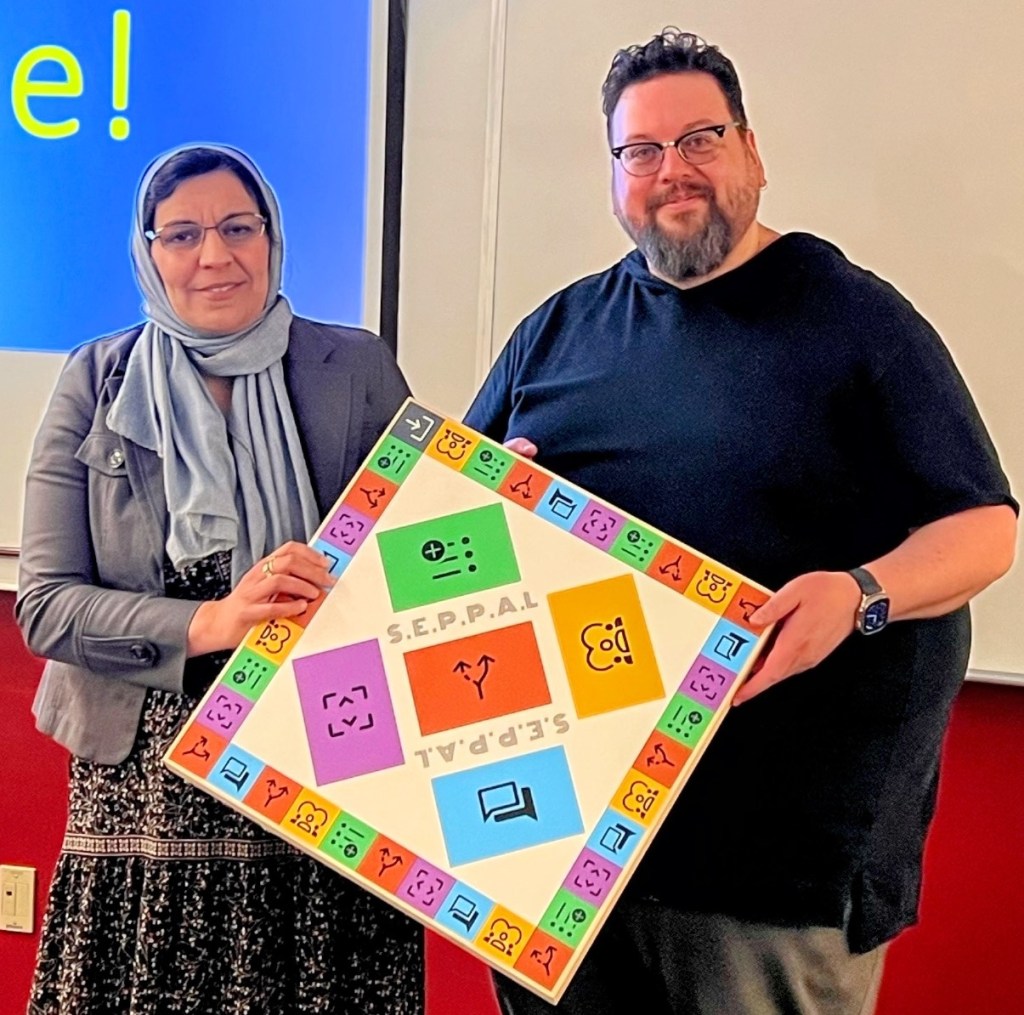
My student Muna (pictured above with yours truly) successfully completed her Masters of Engineering project – congratulations to her! We worked together on developing an engaging educational board game named “SEPPAL: Software Engineering Pre-Project Playtime Active Learning.” This game is designed for early-year software engineering students and aims to teach and reinforce concepts in software engineering and computer science. Additionally, it serves as a fun ice-breaker for team projects. I am looking forward to sharing more details about the board game in an upcoming paper within the next few months.
During the spring term, I had the opportunity to teach ENSE 271. Together with my students, we partnered with Charlene Mclean and Colleen Strauch from the Saskatchewan Career Development Association (SKCDA) to brainstorm fresh website design concepts. An exciting highlight is that one of the students was actually hired during the Summer term to bring the concepts we explored in class to life. The plan is to launch the new website sometime during the upcoming Fall term.
After that, I embarked on a journey to Kelowna, British Columbia for the annual conference of the Canadian Engineering Education Association (CEEA). The road trip took me through the scenic prairies and majestic Rocky Mountains! During the event, I played a role in arranging a workshop within the “Humanities in Engineering” special interest group (as seen in the picture above). Moreover, I shared a paper outlining my investigations into educational technologies spanning the past few years. The response was overwhelmingly positive! The conference also provided a valuable opportunity for me to absorb fresh perspectives on enhancing the appeal and impact of my courses, as I listened to the insights from fellow presenters.
Afterward, I decided to take some well-deserved time off. During this period, I dedicated my efforts to assisting my family with yardwork (the picture above captures my older sister, dad, and I after staining my sister’s deck). Additionally, I’ve been tackling various yard projects in my own space, collaborating with my wife, Nova, to create a serene haven for both us and wildlife. An interesting tidbit: we’ve been fortunate to host a number of monarch butterfly transformations in our yard (see the picture below), with approximately ten or more caterpillars evolving into vibrant butterflies this year! My wife has taken the initiative to document this fascinating journey. Below, you’ll find a collection of images captured by Nova
As we approach the Fall term, I’m still taking some well-deserved rest before diving into preparations for the upcoming semester. Currently, my brother, sister, and I are enjoying the Regina Folk Festival (as shown in the picture below). Following this, I have a bit more yardwork to tackle, and I’m hoping to squeeze in some relaxation time, catching up on TV shows and movies. By the way, have you seen Barbie yet? If not, it’s a must-watch! #fantastic #iamkenough. Soon enough, I’ll be gearing up to get my courses ready for the Fall. I’ll be overseeing both my elective ENSE 405 and the software engineering capstone course (ENSE 400/477). I’m eagerly looking forward to diving back into it all!
Hi all – The 2023 University of Regina Engineering Project Day is fast approaching! This free and open-to-the-public event is on Saturday, April 1 from 8:30 am – 4:30 pm in the Education Building at the University of Regina.
Software engineering students practicing their trade show displays for the 2023 Engineering Capstone Project Day
Engineering Project Day, our annual engineering capstone class where students take on a 2-semester project is fast approaching. This year it’s happening on April 1, 2023, no April fools’ joke…ha. Visible in the pic above is our Software Engineering students in action, practicing their trade show displays for the big upcoming day! It was an awesome time seeing our students come into their own and show of their hard work thus far. Students were also able to gather some last-minute feedback and comments from their student colleagues and software faculty too!
That’s April 1st folks at the University of Regina (Education Building). It is a free all-day event for the public starting at 8:30 am. More details to follow
Another great year for tunes! Before we get to the beef of it all here were 10 often in rotation honourable mentions (in no particular order):
Eddie Vedder, Earthling
3rd Secret, Self-titled
Sharon Van Etten, We’ve Been Going About This All Wrong
Dan Mangan, Being Somewhere
Joel Plaskett, The Window Inn Sessions
The Interrupters, In the Wild
Amon Amarth, The Great Heathen Army
Rammstein, Zeit
Megadeth, The Sick, The Dying…And the Dead
Lamb of God, Omens
OK, and now for my top 10. Albums that were always in rotation throughout the year. Albums that made me ever so happy and will likely continue to do so for ever!
10. Gnome, King. A solid, chunky, mostly instrumental and super fun album. There are some definite groovers here, such as Kraken Wanker, Ambrosius, Wenceslas, and Anitbeast to just name a few
09. Architects, The Classic Symptoms of a Broken Spirit. Hatchi Matchi! Another fantastic album from these fine lads. I often hear the guitar tone from Quake 2 and that makes me so very happy. Favs include: Burn Down My House, When We Were Young, Spit the Bone, and Deep Fake
08. Screeching Weasel, The Awful Disclosures of Screeching Weasel. What we have here is simply a head-bobbin’ classic pop-punk album, with every song from start to finish a toe-tapping event. What a super album! Favs include: Kill to Cure, Six Ways to Sunday, In La Quinta del Sordo, …damn…every damn song is fantastic!
07. Stereophonics, Oochya. In constant rotation for much of the year, a fine album this is indeed. Having been a fan of these folks since their start in the 90s, this album does not disappoint. Every tune is great but to pick a few favs: Right Place Right Time, Do Ya Feel My Love?, You’re My Soul, and Made a Mess Of Me.
06. Envy of None, Self-titled. I came across these folks due to Alex Lifeson (aka, Rush baby!) being in the band. Although a whole lot different than a Rush album, this album is soooooo very good. The ethereal voice of Maiah Wynne as layered around the ethereal and “dreamy/soothing” instruments from the rest of the band, I can’t really say enough good things about it all. Soooo good!! Favs include: Never Said I Love You, Liar, Look Inside, Western Sunset, Dumb….really it’s all good from start to finish!
05. John Moreland, Birds in the Ceiling. Wow! What a voice. What a talent. There is not much more to say. This dude is the real deal. I like every tune on this album but to pick a few favs: Generational Dust, Lion’s Den, Cheap Idols Dressed in Expensive Garbage, and Ugly Faces.
04. Wind Rose, Warfront. I love love love these fine lads. The raw power and shear energy of their tunes. I also am quite drawn to the storytelling from the fantasy/dwarves perspective. This is simply a solid album that was blaring constantly throughout the year. Favs include: Gates of Ekrund, Army of Stone, Tales of War, and The Battle of the Five Armies…actually, it’s all great!
03. Bloodywood, Rakshak. I can’t say enough great things about this band. Not only are they top-shelf musicians, they are the most decent of human beings. I love the mix of “bollywood-esque” with the heaviest of heavy metal. So unique and so very excellent. Favs include: Aaj, Yaad (watch this video until the end, with their animal rights work, such beautiful humans!), Jee Veerey, Gaddaar, Dana-Dan, Machi Bhasad, and ….holey moley this is pointless…it’s all fantastic!
02. Matt Andersen, House to House. One of the best musicians to come out of this fine nation of ours. Such a voice, such talent. Every song on this album is gold, but to pick a few favs: Let Me Hold You, Other Side of Goodbye, Time for the Wicked to Rest, Raise up your Glass, House to House…bah…every damn song is fine!
01. Taylor Swift, Midnights. OK – hear me out here…ha. Just wait a darn minute now…haha. I know I may take some flack for this pick, particularly since it being my number 1 pick, but since her album Folklore, I’ve been a huge fan! Since coming out in October this album has been in a constant daily rotation…yes…daily. As with my number 2 pick with Matt Andersen, Taylor Swift is quite simply a gem – one that only comes around ever so rarely. It’s all good but favs include: Anti-Hero, You’re On Your Own Kid, Maroon, Sweet Nothing, Lavender Haze, Karma, Bejeweled, …I’ll stop now…every tune on this album is excellent (and no, I’m not losing my mind…haha)
And there we have it. 2022 was another great year for music. Looking forward to what 2023 has to offer the world!
2022 was an interesting year. The world started opening back up, which after 2 years in isolation, was exciting and scary all at the same time.
SSEers in Lego-making action!Making an RV? What? 🙂
My teaching evolved into something different, with my teaching philosophy changed in a way I didn’t think it ever would. The changes largely due to our forced COVID experiences of the past few years has me thinking in new and exciting ways that I am wanting to continue to explore from the lens of how best to support my students but also myself and other educators (from the perspective of Mepham’s matrix of autonomy, fairness, well-being – an idea carried over from my PhD days). Regardless, I’m excited to continue the journey of how best I can support the future software designers and developers of the world. Indeed some of it is trial and error but I am thankful for my students who, even though at times are forced to come along for the ride with me as I teach core and required classes, nonetheless come along and provide me with open and honest feedback along the way. Engineering students really are a great bunch to hang out with throughout my days!
I attended my first academic conference since coming on board with the Faculty of Engineering and Applied Science at the University of Regina in 2017. Wrote two peer-reviewed and accepted papers to boot! The conference – CEEA-ACEG’s (Canadian Engineering Education Association) annual event – this year it was at York University in Toronto – my first conference since my PhD days. The conference was ever so fun as I got to link up with like-minded educators in engineering and science. Folks met over Zoom over the last few years but it was nice to connect with them in-person. The CEEA folks are so inspiring and I am glad to have decided to be attached in some way to the community.
I received official recognition at work for my experiential and reflective-based teaching practices and got to meet others who also demonstrated interesting and unique teaching practices who also received similar recognition as well. Even more crazy was I got a certificate to highlight my work as well as attend an event where I got to meet and shake the hand of our new university president and our new dean of engineering. I have realized I am thankful and grateful for having a gig that officially recognizes folks who take the time to go outside the box and take initiative to explore new ways of exploring and honing their craft in a safe-to-fall way (Kudos to Dr. Alec Couros for creating these fantastic teaching recognitions). My old gig did this too, they just took more of a fail-safe approach to it all – a kind of “ya explore away, but if the shit hits the fan, the fun (might) need(s) to be over.” Having said this, I am also ever so grateful for my past experiences too as without key folks giving this crazy guy a little leeway and flexibility to be crazy and creative I wouldn’t be who I am today (i.e. super thankful for the Jacky Hoffert’s, Cindy Ikola’s, Shannon Waugh’s, Chris Zimmer’s and Wilbour Craddock’s of the world)
Pippin, Nova, and I went through a rather scary event where Pippin almost lost his life due to a bloated stomach. Gladly he is back to his normal and annoying, but super awesome self. He really is our world and we love this little big guy ever so much!
Doh!Woohoo!!
COVID finally hit Nova and I and let me tell ya, it was an experience I would have rather done without but seemed inevitable. As we near the close of December we are both COVID-clear but I am still experiencing some long-COVID-type symptoms – the dry coughing, brain fog, and sinus fun. Hopefully, this clears soon. I was one of the unfortunates who during COVID lost all sense of taste and smell along with all of the other stomach and sinus fun. Thankful for vaccines though as maybe it could have been a worse time
I also re-started the gym thing after a 2-year hiatus due to COVID. This has had a really positive impact on me mentally and physically as I try to get back on track to having more healthy internals (I’ll likely always be a big dude as food is life, but I can tighten up the internals indeed). Also if I can get rid of some of those external “COVID cupcakes” mostly seen around the stomach region (haha), gained throughout COVID, even better! 🙂
Overall, reflecting back on 2022 – hills and valleys aside – another fine year! Stay tuned for my albums of the year coming soon!
The first paper above, “Facilitating Cross & Beyond Course Project-Based Software Engineering Learning Experiences,” details a process I have been exploring since being hired as a lecturer in the Software Systems Engineering (SSE) program, the general premise is the exploration of a process for educators, students, and industry collaborators to build on and continue iterating on the good work students produce within project-based courses. The paper discusses a learning experience that took place in 2018 with my graduate and undergraduate students, and my previous place of work, eHealth Saskatchewan. I’ve since been exploring the use of the process in other courses as well throughout the years, facilitating successful and/or interesting collaborations between students and industry partners (particularly with the Regina Fire & Protective Services, Internation Association of Business Communicators (Regina branch), the Regina Food Bank, and most recently the Regina Mandolin Orchestra so far). I hope to continue exploring this process this Winter as I engage in a new collaboration with Luther College’s Nonprofit & Voluntary Studies Network in future class offerings
The 2022 CEEA conference was really amazing. It was my first time attending the conference. I learned so much and connected with so many excellent folks from all across Canada doing great work in Engineering (and STEAM – Science, Technology, Engineering, Arts, and Mathematics) education. Plans are currently underway for a paper(s) submission to the CEEA 2023 event which will be at UBC/Kelowna. Super excited!
With that, it is my plan over the next month and a bit to take some time off to recoup and rest up, coming back strong in mid-to-late August 2022 to prep for the Fall 2022 term! I am looking forward to taking a much-needed break as I reflect on the past couple of years, being thrust into COVID response back in March 2020, seemingly working non-stop until now (Summer 2022) trying to keep my head above water and trying my best to evolve my teaching while providing the best possible learning experiences to my students. I’ve learned a lot over the last little bit and hope to continue to explore, as although COVID wasn’t really a great thing that happened to us all and it really was a reactive “fly-by-the-seat-of-our-pants” response, I do think some good emerged from all of my crazy explorations and experiences (and this just might be the premise of my next CEEA paper #hint …haha 😉
Have a great summer all. If you do reach out please know I will be taking a break from it all and will respond when I can!